

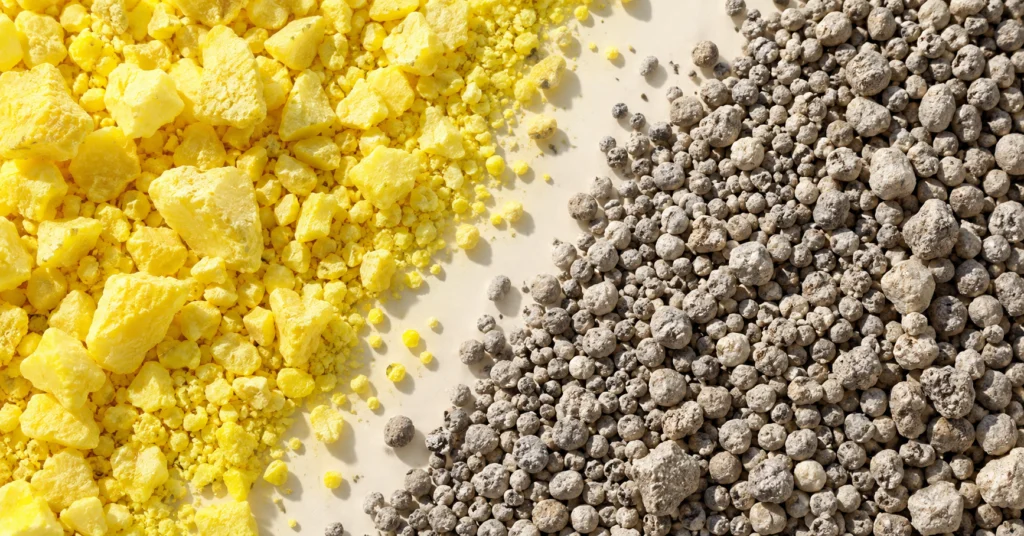

Global sulphur exports fell almost 40% year on year in the first half of 2026, according to a Rabobank update published on 16 September. The bank links the contraction to record sulphur prices and higher phosphate production costs. It forecasts a 7% decline in global phosphate fertilizer demand this year. Its assessment points to a market where expensive raw materials continue to constrain both production economics and farmers’ purchasing power.
Source: Rabobank’s 16 September update
The connection between sulphur and phosphate fertilizer begins before the finished granules reach a warehouse. Sulphur is a major industrial raw material, with sulphuric acid production its principal end use. The U.S. Geological Survey identifies that acid as an important input across industrial and fertilizer manufacturing. This gives developments in the sulphur market significance well beyond the trade in the yellow material itself.
Source: USGS: sulphur
In the wet-process route used to manufacture fertilizer-grade phosphoric acid, sulphuric acid reacts with phosphate rock. The reaction produces phosphoric acid and gypsum, which must be separated by filtration. The acid can then be concentrated to meet the requirements of fertilizer production. The process described by the U.S. Environmental Protection Agency explains why access to phosphate rock alone does not resolve the raw-material requirements of a fertilizer plant.
Source: EPA: phosphoric acid production
That processing step connects the sulphur market to the cost of making phosphate fertilizers. It adds a separate supply requirement between mining the rock and producing the material used on farms. Consequently, the economics of fertilizer manufacturing depend on inputs from more than one commodity market.
Source: EPA process description
The operational effects were already visible before today’s report. In an update dated 27 August, Mosaic said sulphur prices had exceeded US$1,000 per tonne globally during the Middle East conflict. It reported idling its Uncle Sam and Faustina facilities in Louisiana and reducing production in Florida. The company linked these adjustments to sulphur availability and affordability, providing a concrete example of raw-material pressures affecting phosphate production.
Source: Mosaic’s August update
Farm budgets show the other side of the pressure. In its forecast updated on 3 September, the U.S. Department of Agriculture projected that American farm spending on fertilizers, lime and soil conditioners would increase by US$5.3 billion, or 15.3%, in 2026. This is a combined spending category, covering more than phosphate fertilizers. It measures expenditure rather than a price change for a single product, so it should not be read as a phosphate price index.
Source: USDA farm-sector forecast
USDA also forecast a US$4.8 billion increase in fuel and oil expenses, equivalent to 28.8%. Total farm production expenses were projected to reach US$492.8 billion, up 4.5% in nominal terms from 2025. These figures show several cost pressures arriving together. They do not attribute the entire increase in farm expenditure to sulphur, but they establish the broader financial setting in which fertilizer purchases are being made.
Source: USDA production expenses
A separate American Farm Bureau Federation analysis published on 15 September found that improved revenue expectations for crops including corn and soybeans were being eroded by higher fertilizer and diesel costs. Its calculations indicated that no major row crop was projected to cover total production costs in the 2026/27 marketing year. That is the organisation’s forecast for U.S. crop economics, rather than a statement that every individual farm will make a loss.
Source: Farm Bureau analysis
Taken together, the evidence points to pressure at both ends of the phosphate market. Producers need economically viable access to processing inputs, while buyers face competing demands on their budgets. An improvement in one part of the supply chain would therefore not, by itself, establish a recovery across the whole market. The next evidence of relief will have to come from production conditions and the economics of using the finished fertilizer.