


I. Introduction
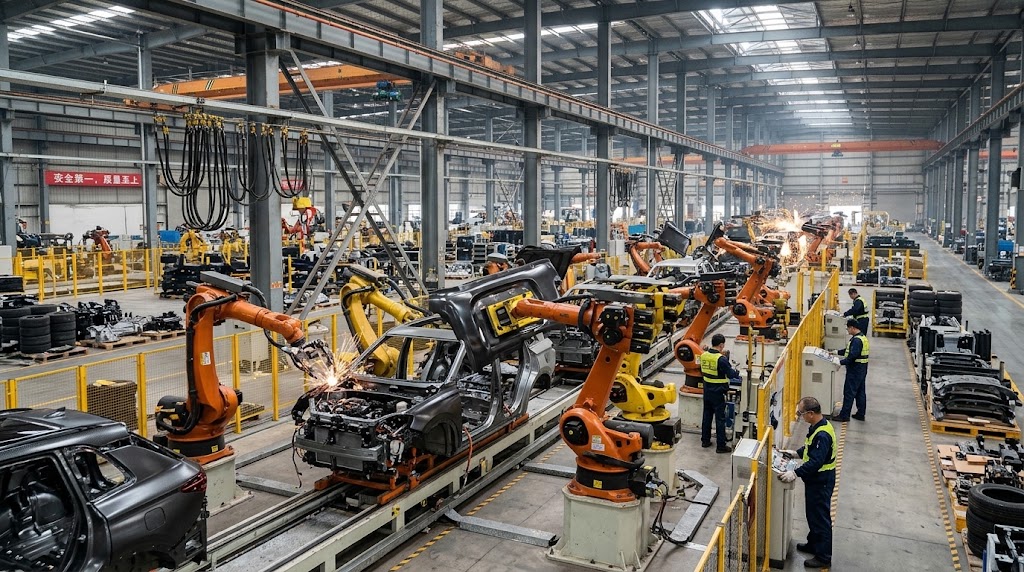
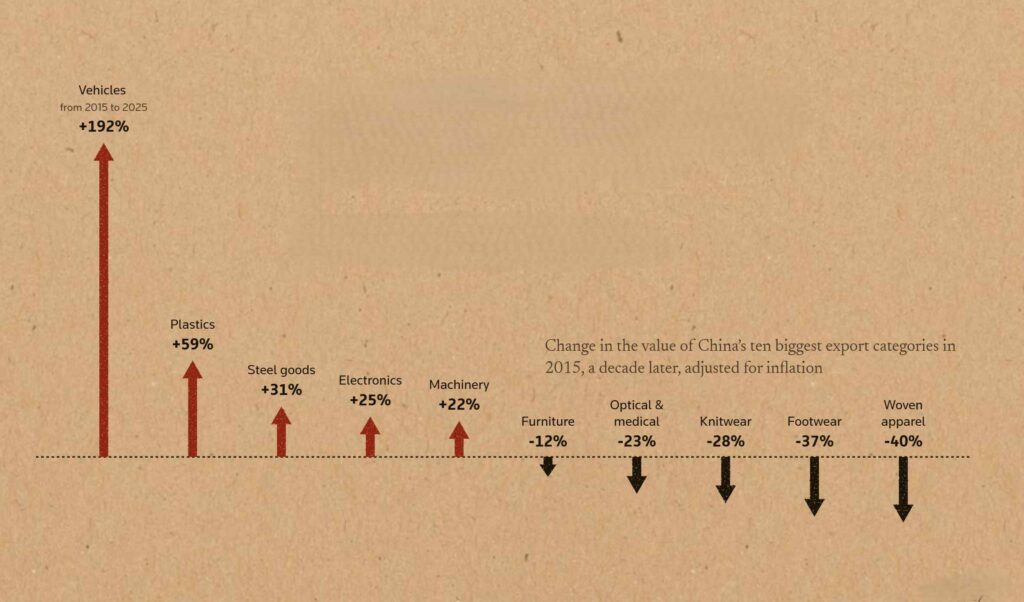
For decades, the „Made in China” designation was virtually synonymous with low-margin consumer goods, such as inexpensive apparel and basic plastic commodities. Today, that paradigm has shifted dramatically, with Chinese manufacturing pivoting toward high-quality, technologically advanced outputs like electric vehicles. This structural transformation is rapidly displacing traditional exports, which are currently experiencing stagnation, in favor of sophisticated product categories historically dominated by European, Japanese, and American producers.
The automotive sector serves as the most prominent indicator of this transition—and a primary catalyst for international trade friction. Chinese vehicle export volumes now exceed those of Germany and the United States combined. Simultaneously, foreign sales of complex industrial machinery, advanced specialty chemicals, and data center infrastructure are experiencing unprecedented growth.
Picture No 1.
Source: https://www.reuters.com/graphics/CHINA-ECONOMY/TRADE-OBJECTS/moparrmewva/ — Welcome to the new „Made in China”
This technological leap is the direct outcome of a sustained, decade-long state strategy designed to elevate China’s position within the global manufacturing value chain. Substantial government subsidies continue to stimulate industrial expansion, acting as a critical economic stabilizer to counteract a prolonged domestic real estate crisis and subdued internal consumption. Consequently, while the global market benefits from an influx of accessible, modern technologies, this heightened competitive pressure poses a severe structural threat to manufacturing employment across Western industrialized economies.
II. Artificial Intelligence
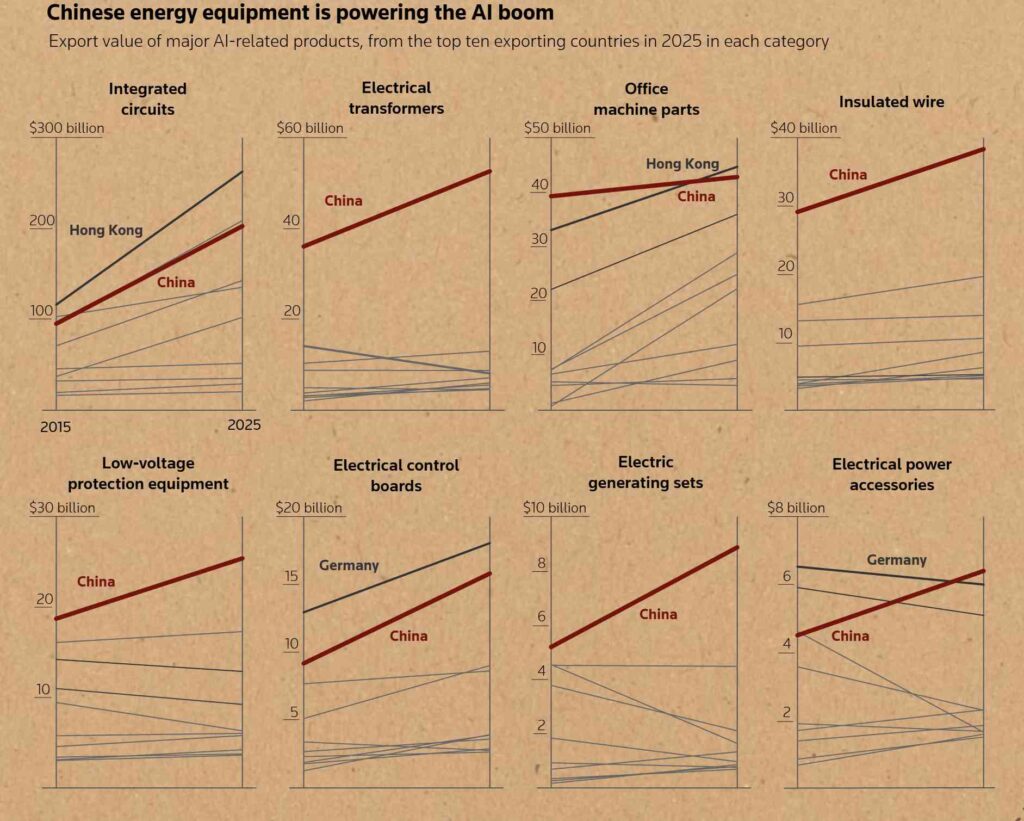
While the design and fabrication of cutting-edge artificial intelligence semiconductors remain dominated by American firms and Taiwanese foundries, China commands the expansive, cost-competitive hardware ecosystem that surrounds these core components. China essentially underpins the global supply chain for mature-node semiconductors, standard memory modules, server peripherals, and the critical physical infrastructure of data centers, including transformers, cabling, and control boards.
Furthermore, Chinese energy and infrastructural equipment act as foundational drivers of the current AI expansion.
Picture No 2.
Source: https://www.reuters.com/graphics/CHINA-ECONOMY/TRADE-OBJECTS/moparrmewva/ — Welcome to the new „Made in China”
Market data analyzing key AI-hardware components between 2015 and 2025 (adjusted to 2025 USD) illustrates a consistent upward trajectory in Chinese export values. Across eight primary hardware categories, China’s export volumes have grown universally, securing the position of top global exporter in five of these segments (Methodological note: While these categories encompass essential AI infrastructure, they also capture broader tech commodities; customs data for China and Hong Kong are reported separately, with the latter including re-exports).
As noted by Ruby Osman, senior geopolitical advisor at the Tony Blair Institute for Global Change, the AI revolution is fundamentally reshaping China’s international trade dynamics. Beyond the most advanced processors, China maintains a commanding lead in the production of mature chips and the essential physical inputs required to operationalize AI technologies. This dominance is reflected in recent trade metrics: during the first half of 2026, Chinese semiconductor shipments surged by nearly 100%, reaching $177.28 billion, while computer and server exports recorded a robust 41.3% increase.
III. The Chemical Sector
For years, the presence of the Chinese chemical industry in everyday consumer environments was largely confined to basic, low-margin commodities—ranging from wall paints, upholstery foam, and refuse bags to standard personal care ingredients. Under this traditional economic model, China focused on manufacturing high-volume base chemicals while importing advanced, high-margin chemical compounds from European, American, and Japanese markets.
Today, Chinese manufacturers are systematically ascending the global value chain by introducing technologically advanced engineering materials to the market. A clear indicator of this transformation is the growing share of Chinese components in high-value-added applications, such as flexible polymers used in automotive body panels, photovoltaic installation components, and carbon fiber utilized in high-performance road bicycles.
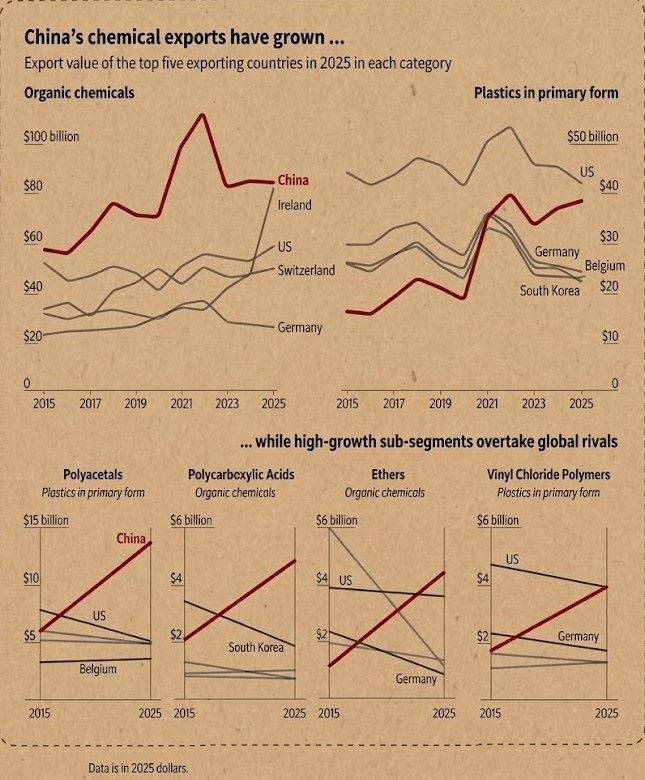
Export data from 2015 to 2025 (in real terms, adjusted to 2025 USD) illustrates China’s rapid expansion across international markets. In two primary categories—organic chemicals and plastics in primary forms—China recorded substantial growth in foreign sales value, securing a position among the world’s top two exporters. Even more pronounced dominance is evident across four high-growth specialized sub-segments (comprising polyacetals, polycarboxylic acids, ethers, and vinyl chloride polymers), where Chinese exports have overtaken global competitors to establish the country as the world’s leading supplier.
Large-scale state support remains the primary catalyst behind this expansion. According to OECD data, the Chinese chemical sector received approximately $75 billion in government subsidies over the past decade, peaking in 2023 at nearly $15 billion.
Picture No 3.
Source: https://www.reuters.com/graphics/CHINA-ECONOMY/TRADE-OBJECTS/moparrmewva/ — Welcome to the new „Made in China”
This fiscal stimulus triggered a rapid surge in production capacity; according to Chinese statistics, roughly 5,000 new chemical enterprises were registered between 2018 and 2023. This influx generated severe overcapacity in commodity chemicals (such as those used in footwear and industrial adhesives), forcing some facilities to idle operations while prompting producers to aggressively offload excess inventory onto international markets. Consequently, leading global corporations—including BASF, Dow, LyondellBasell, Sumitomo Chemical, INEOS, and Mitsubishi Chemical—have issued formal warnings to investors over the past year, highlighting that the sheer scale of Chinese production and resulting price pressures pose a direct threat to their profit margins and financial performance.
IV. Factory Equipment
Consider an economy heavily dependent on imports from China, where a widening trade deficit has escalated into a major political issue, factories are shuttering, and workers are losing their jobs.
The intuitive remedy seems straightforward: identify the goods China sells too cheaply, impose tariffs on them, and rebuild domestic industry by constructing new factories—a strategy actively pursued by U.S. President Donald Trump.
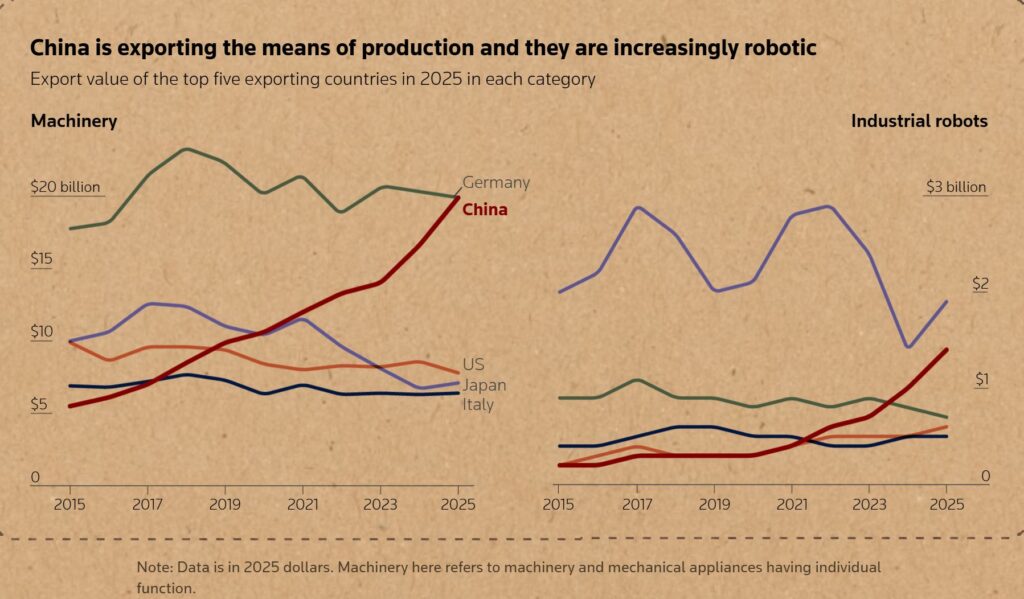
The catch, however, is that China has evolved into the „factory for factories.” Exports of Chinese industrial robots have surged by over 300% since 2015, capturing market share from American, German, and Italian manufacturers whose shipment volumes have declined. Simultaneously, China has overtaken Germany to become the world’s largest exporter of machine tools.
Statistical data for the 2015–2025 period confirms this trend: in the general machinery segment, China has steadily increased its exports to match the top exporter, Germany, while in industrial robots, it now ranks second globally behind Japan.
Although Europe still maintains a strong foothold in capital goods, its dominance is eroding. Goldman Sachs estimates that Europe’s share of global demand in volume terms has fallen from 54% in 2005 to 43%, whereas China’s share has climbed from 7% to 24%.
Picture No 4.
Source: https://www.reuters.com/graphics/CHINA-ECONOMY/TRADE-OBJECTS/moparrmewva/ — Welcome to the new „Made in China”
Even though sophisticated European technologies—such as German optics and Dutch semiconductor lithography machines—remain exceedingly difficult to replicate, China is rapidly ascending the value chain across a wide array of more conventional yet essential machinery required to equip a modern production plant. As Fred Neumann, Chief Asia Economist at HSBC, points out: „Building a factory may require Chinese machinery, but the bigger issue is that the production process itself will likely remain dependent on Chinese-made components.”
V. Vehicles
„No one is attracting the opposite sex, or indeed the same sex, in this car.” So began one review of the Chinese Leapmotor 7 SUV. British motoring pundit Jeremy Clarkson was ruder still about the BYD Seal 6, which he described as „Chinese wallpaper paste with windscreen wipers.” European drivers do not seem to agree. According to the European Automobile Manufacturers’ Association, sales of models made by China’s Leapmotor in Europe rose 558% in the first half of this year compared with the same period in 2025, while sales of BYD models are up 146%.
Picture No 5.
Source: https://www.reuters.com/graphics/CHINA-ECONOMY/TRADE-OBJECTS/moparrmewva/ — Welcome to the new „Made in China”
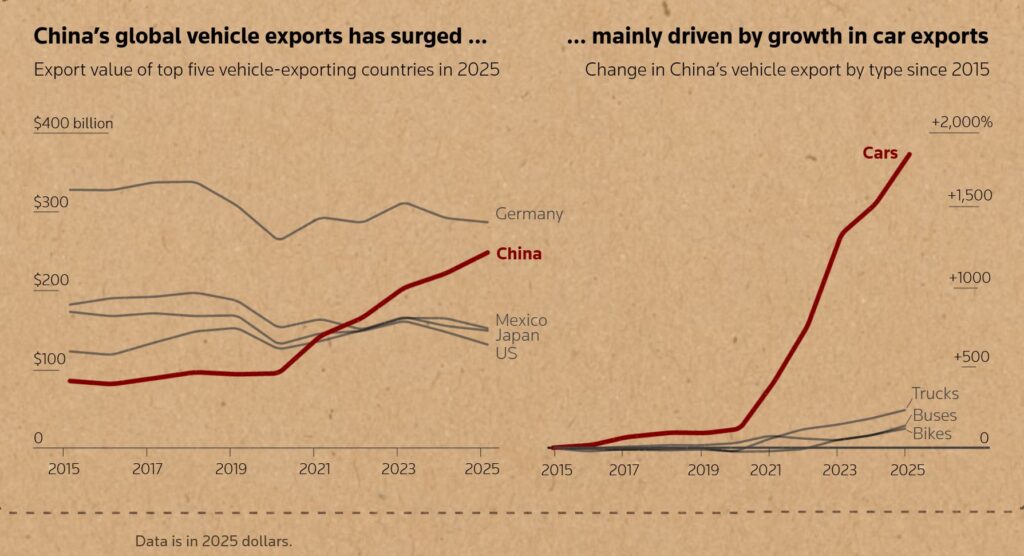
Affordable Chinese cars have become the poster child for the country’s export boom, prompting the U.S. and Europe to erect trade barriers to protect their domestic automakers from fierce Chinese competition. China’s global vehicle exports have surged dramatically. Statistical data illustrates this through two side-by-side line charts: the first shows that the value of China’s vehicle exports rose steadily from 2015 to 2025, establishing it as the second-largest exporter after Germany; the other displays the percentage change in exports across various vehicle types from China, demonstrating that by far the largest increase has been in cars (all data expressed in 2025 USD). They are popular because they are cheap, and they are cheap simply because there is an overabundance of them, churned out by Chinese factories unable to sell them domestically. Consequently, the value of Chinese car shipments has soared by 1,871% since 2015, with growth accelerating sharply from 2020 onward as manufacturers were forced to look overseas for buyers. Echoing the „Japan shock” of the 1980s, Europe and the U.S. have responded by putting up trade barriers against Chinese vehicles.
VI. Smart Household Appliances
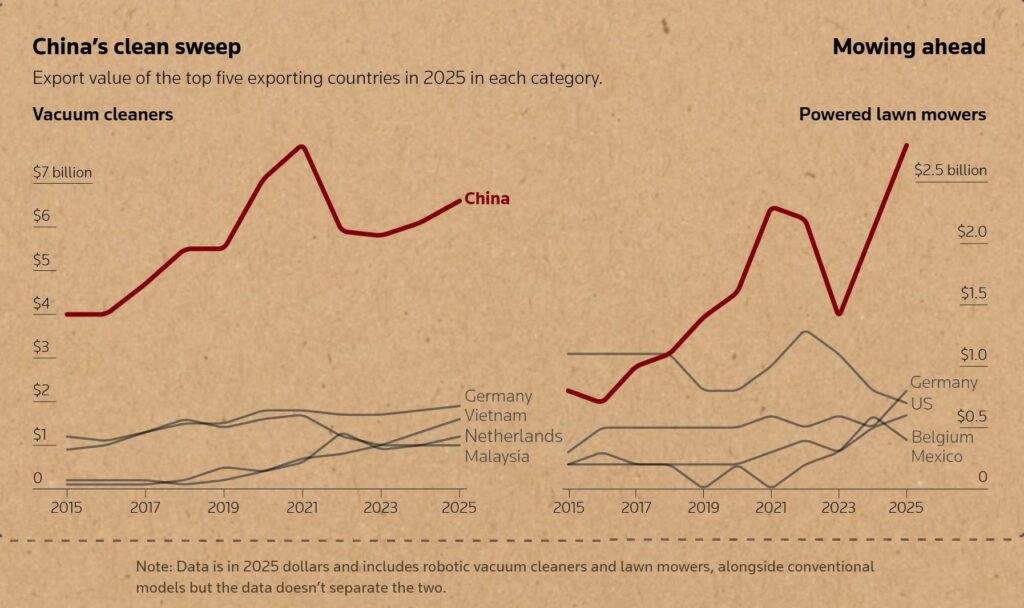
China has very few residential lawns, but it produces a massive number of robotic lawnmowers. With practically no domestic market to speak of, Chinese manufacturers are forced to sell them overseas, rapidly overwhelming foreign rivals. While China has long been a leading producer of low-cost consumer electronics, its companies are now aggressively moving into high-end smart appliances.
Picture No 6.
Source: https://www.reuters.com/graphics/CHINA-ECONOMY/TRADE-OBJECTS/moparrmewva/ — Welcome to the new „Made in China”
This transition enables them to find new ways to monetize the artificial intelligence, big data, and satellite-positioning systems they originally developed to capitalize on a state-backed boom within the saturated automotive industry. For instance, robotic mowers utilize the same high-precision satellite positioning technology found in EV advanced driver-assistance systems, allowing them to map lawns and operate within virtual boundaries. Moreover, they are manufacturing these devices at a rate that has proved devastating for Western competitors. iRobot, the Massachusetts-based company behind the Roomba robotic vacuum cleaner, filed for bankruptcy last December after losing ground to Chinese competitors such as Picea—a home appliance manufacturer based in the southern technology hub of Shenzhen that was once its supplier and ultimately became its owner. For robotic lawnmower manufacturers, the grass is greener in Europe. The continent is the world’s largest buyer of robotic lawnmowers, and Chinese firms have aggressively carved out a major market share. Last November, Brussels launched an anti-dumping investigation after a local manufacturer complained that Chinese rivals were undercutting domestic prices by approximately 40%. The United States has borne the heaviest losses from China’s expansion into powered mowers: U.S. shipments slumped to $746 million last year from $1 billion in 2023, while Chinese shipments more than doubled, surging from $1.3 billion to $2.8 billion.