
The agreement is part of the EU’s strategy to diversify global trade partnerships and create more efficient supply chains. Cooperation with Australia is comprehensive and includes security and defense, research and innovation, education, digital technologies, climate, and the environment. The EU and Australia have also signed a partnership in the field of security and defense. The modernized bilateral agreement on wine will ensure the continued protection of over 1,600 EU wine geographical indications, including about 50 new indications. All imports from Australia will continue to be subject to strict EU health and safety regulations. The agreement may enter into force upon its ratification by Australia.
EU-Australia trade deal in a nutshell
The EU and Australia concluded negotiations on a free trade agreement in March 2026. The agreement will
- remove over 99% of tariffs on EU exports to Australia
- improve access to critical raw materials
- strengthen strategic ties with the Indo-Pacific
The deal is part of the EU’s strategy to diversify global trade partnerships and strengthen supply chains. Cooperation with Australia is wide-ranging and covers security and defence, research and innovation, education, digital, climate, environment. The EU and Australia also signed a Security and Defence Partnership.
Main benefits
The EU and Australia already trade over €89.2 billion in goods and services annually, supporting 460,000 jobs across the EU. The agreement is expected to have a strong positive impact on EU’s economy.
- up to €1 billion – in annual duty savings for EU exporters
- 33% increase – in EU annual exports over the next decade
- €4 billion – expected increase in EU GDP by 2030.
Beyond the numbers, the agreement will:
- give EU companies legal certainty through stable and predictable rules
- help businesses of all sizes plan for long-term growth in Australia
- secure supply chains for critical raw materials
- strengthen the protection of EU intellectual property
- help to prevent counterfeiting and other infringements
Which industries will benefit from tariff reductions
Goods
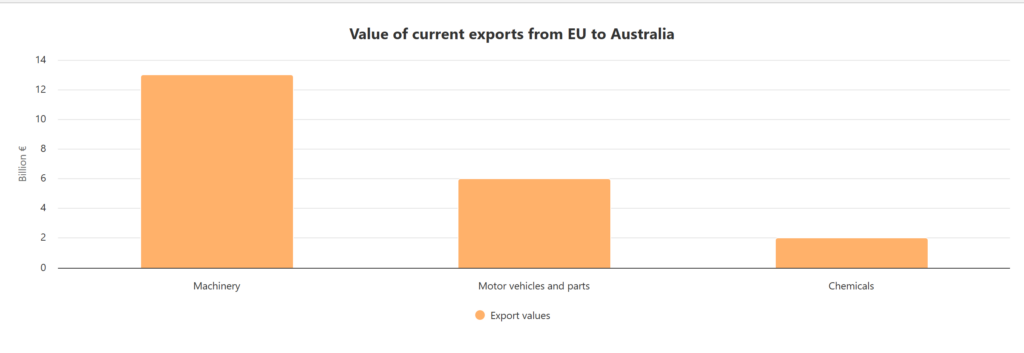
EU exporters of machinery, motor vehicles, and chemicals gain the most immediate benefit. Tariffs on these goods, worth billions of euros in export, are eliminated from day one of the agreement.
Source: EU Australia Trade Agreement
Services
In services, EU companies will gain improved access in
- professional and business services,
- maritime transport and
- financial services.
The agreement also sets rules on data flows and prohibits data localisation requirements, which is an important step for digital and tech companies.
What are the benefits for farmers and food producers
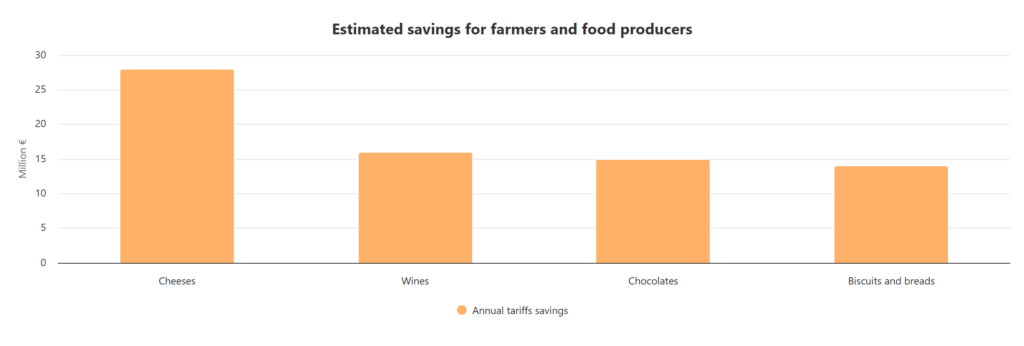
EU farmers will have new export opportunities as Australia eliminates tariffs on key products such as cheese, wine, chocolate or biscuits and breads.
Source: EU Australia Trade Agreement
At the same time, sensitive sectors in the EU are protected through import limits.
For sensitive agricultural sectors – including beef, sheep and goat meat, sugar, rice, and certain dairy products – the agreement will allow imports from Australia at zero or reduced tariffs only in limited amounts and subject to certain conditions.
A safeguard mechanism will allow the EU to act quickly if a surge in Australian imports causes difficulties for EU farmers.
The agreement will also protect EU geographical indications (GI), meaning names like Champagne or Parmigiano Reggiano, can only be used for products genuinely made in their designated regions. This includes
- 165 agricultural and food products
- 231 spirit drinks
A modernised bilateral wine agreement will further protect more than 1,600 EU wine GIs, including around 50 new additions.
All imports from Australia will remain subject to the EU’s stringent health and safety regulations.
How does the deal secure Europe’s supply of critical raw materials
Australia is a major producer of aluminium, lithium, and manganese, all essential for EU industry, particularly for clean energy and digital technologies.
The agreement will reduce or eliminate tariffs on these materials and enhance cooperation between the EU and Australia on supply chain security.
This matters because the EU relies heavily on import of critical raw materials, and global demand is rising. Diversifying supply will help ensure continuity for strategic industries such as electric vehicles, battery production and renewable energy.
The agreement includes special environmental and safety provisions to ensure that the extraction of these materials is carried out sustainably, and both sides have agreed to enhance cooperation on critical raw materials, including co-financing related projects.
What environmental and social standards does the agreement include
The agreement is about more than just trade. It includes legally binding commitments on climate, labour rights and environmental protection. Key sustainability commitments include
- upholding the core principles of the International Labour Organisation (ILO), including the elimination of child labour and the protection of freedom of association
- implementing all ratified treaties protecting women’s rights
- combating deforestation, illegal wildlife trade, and illegal fishing
- implementing the Paris Climate Agreement
- applying EU health and safety rules to all imports from Australia
The deal also liberalises trade in green goods and services, such as renewable energy and energy efficient products.
When will the agreement enter into force?
The ratification steps are
- Publication of the negotiated draft texts
- Legal revision
- Proposal to the Council of the EU for signature and conclusion
- Adoption by the Council
- Signing of the agreement by the EU and Australia
- European Parliament’s agreement to the deal
- The Council’s decision on concluding the deal
Once Australia also ratifies the agreement, it can enter into force.