
A Stark Statistical Reality
The World Bank’s monthly commodity report, released on Thursday evening, provides a stark statistical look at this market upheaval. Data for March 2026 shows the energy index surging by 41.6% (rising from 92 to 130 points), while the fertilizer index climbed 26.2% (from 145 to 183 points). These shifts mirror the energy crunch caused by the Hormuz Strait blockade and the destruction of gas facilities in the Middle East. The fallout was immediate: European natural gas prices spiked by 59.4%, and crude oil rose by 40.5%. Farmers face a twofold crisis—fertilizer prices are being driven up both by record-high input costs (natural gas) and the logistical impossibility of moving finished goods and raw materials out of the Persian Gulf.
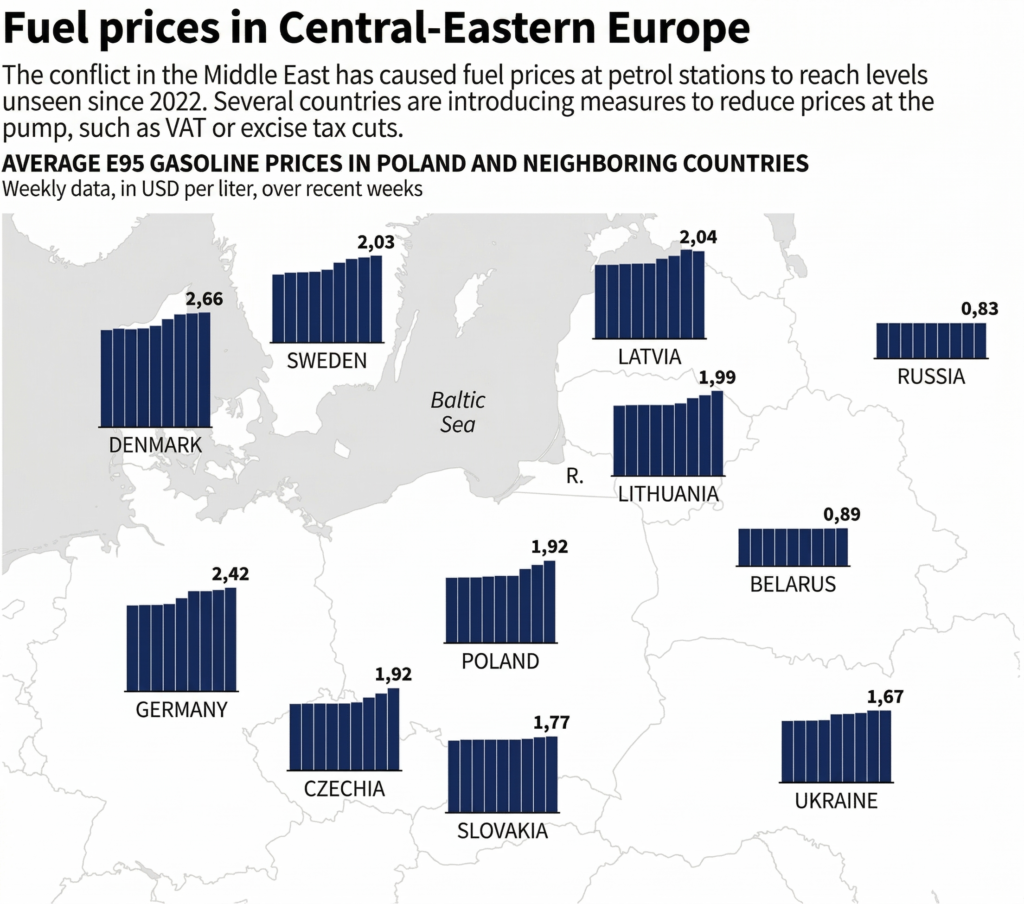
https://www.rp.pl/rolnictwo/art44100151-wielki-wzrost-cen-w-rolnictwie-przez-wojne-indeks-cen-nawozow-wzrosl-o-26-proc „Fuel prices in Central and Eastern Europe”
Supply Chain Fragility and Regional Impact
The Middle East remains a cornerstone of the global fertilizer trade, accounting for 49% of worldwide urea exports. The current paralysis of maritime routes has caused widespread alarm. In Poland, major producers like the Puławy Nitrogen Works briefly halted order intake in response to the volatility. Industry analysts, including Arkadiusz Zalewski, point out that the high concentration of production in the Persian Gulf makes the global market hypersensitive to military escalations. Since January, global urea prices have soared by an estimated 77%.
The CBAM Debate in the European Union
The crisis has reignited a political tug-of-war in Brussels over the Carbon Border Adjustment Mechanism (CBAM). While some member states are calling for its suspension to ease fertilizer prices, the European Commission remains cautious, prioritizing the protection of EU-based manufacturers. Polish industry leaders and government officials have voiced support for maintaining CBAM to prevent over-reliance on foreign imports. Instead, Agricultural Commissioner Christophe Hansen has proposed alternative relief measures, including duty-free import quotas for ammonia and urea from non-Russian sources and a comprehensive „Fertilizer Action Plan” scheduled for May 2026.
Market Contrasts: Gold and Cocoa on the Decline
In a surprising turn for a period of war, precious metals have not served as the usual safe haven; gold prices dipped to $4,856 per ounce in March. Even more striking is the collapse of cocoa prices, which are now nearly three times lower than they were during the same period last year, marking a sharp contrast to the soaring costs seen in the energy and chemical sectors.