
1. Gartner’s Top Strategic Technology Trends for 2026
The 10 technology trends reflect – as shown in Gartner’s Top Strategic Technology Trends for 2026 – how leading organizations are responding to complexity and opportunity in an AI-powered, hyperconnected world.
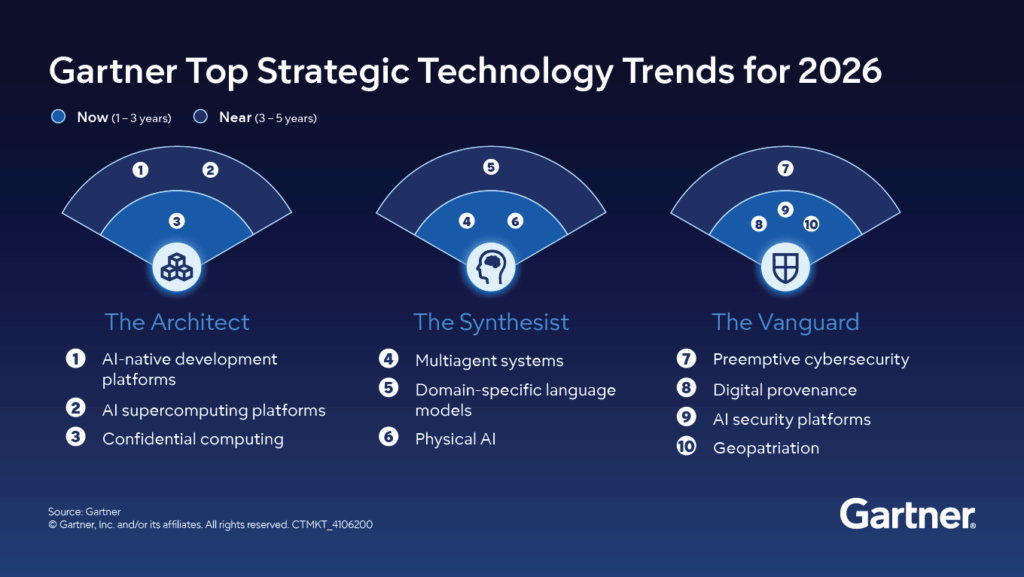
Source: Gartner — Gartner Top 10 Strategic Technology Trends for 2026
Experts predict that by 2026, 30% of B2B sales interactions will take place within so-called Digital Sales Rooms. Companies are moving away from traditional, fragmented email-based negotiations in favor of centralized digital environments, where buyers can act autonomously and in real-time.
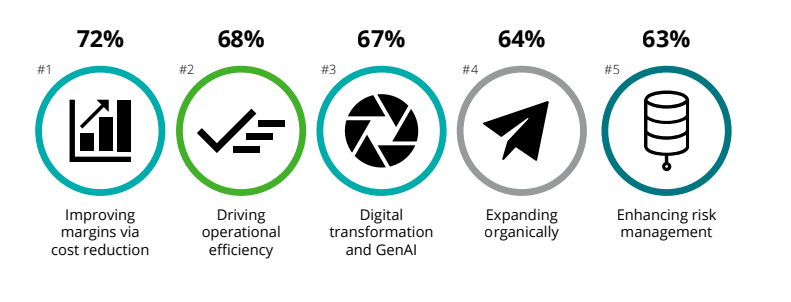
2. Deloitte’s 2025 Global Chief Procurement Officer (CPO) Survey, Agents of change: Procurement’s big bet on digital, reveals the top enterprise priorities for 2025
As organizations confront economic uncertainty, geopolitical tensions, and technological disruption, procurement’s strategic priorities continue to evolve. The Deloitte survey 2025 Global Chief Procurement Officer (CPO);. Agents of change: Procurement’s big bet on digital reveals the top enterprise priorities:
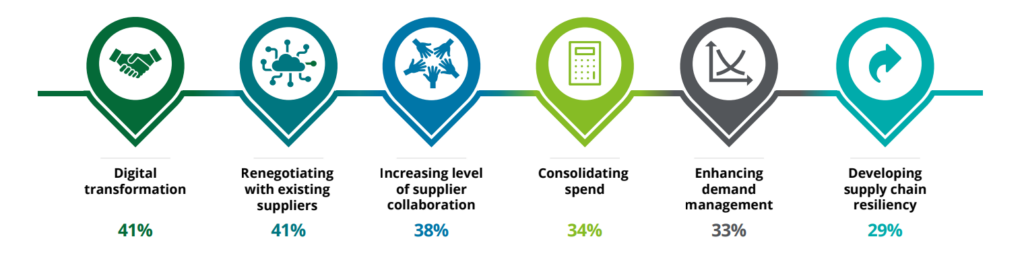
When Deloitte asked about the strategies that are expected to actually deliver the most value in 2025, CPOs highlighted:
Because digital transformation requires investment, decision-makers plan larger budgets for procurement technology in the next fiscal year:
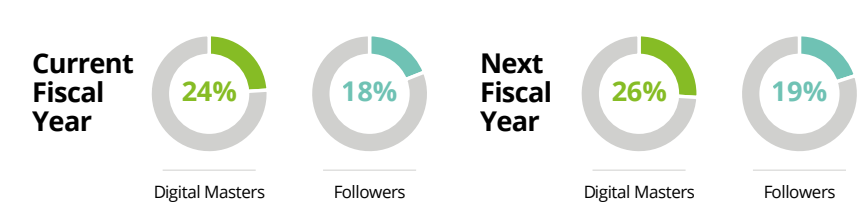
*Digital Masters – achieve better business efficiency
Source: Deloitte — 2025 Global Chief Procurement Officer (CPO) survey
3. Allianz Trade Global Survey 2025; Trade war, trade deals and their impacts on companies
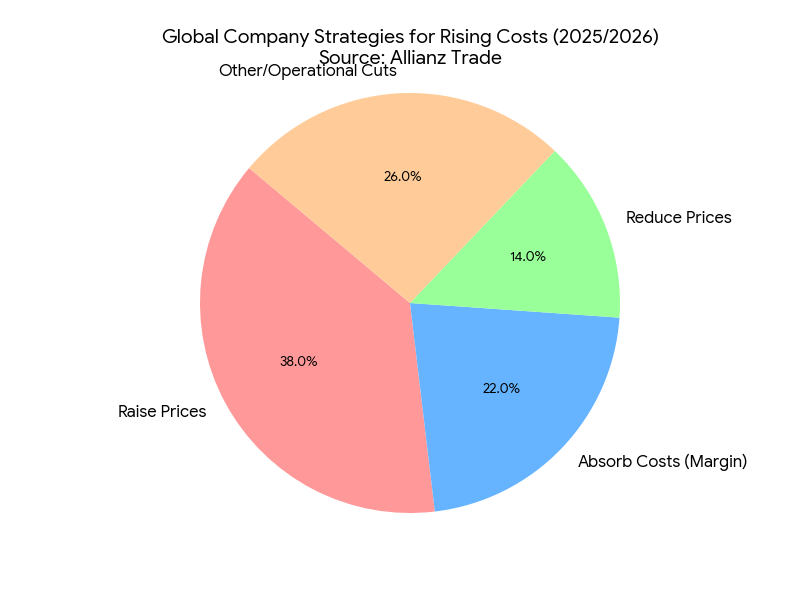
The Allianz Trade 2025 Global Survey report, Trade war, trade deals and their impacts on companies, presents insightful data and strategic approaches to navigating the business landscape:
-
only 22% of surveyed companies intend to absorb higher costs within their own margins. Furthermore, a mere 14% of global players (and only 3% in China) are considering price reductions to maintain market share;
-
as many as 38% of surveyed firms (including 54% in the US and 45% in China) explicitly state that they will raise prices for their customers;
-
companies are safeguarding profitability by cutting operating costs and pausing major investments—a priority reported by as many as 45% of German firms;
-
in the global market, buyers are increasingly forcing suppliers to use the DDP (Delivered Duty Paid) formula, shifting full responsibility for complex logistics and customs duties onto the seller (preferred by approximately 39% of buyers). Additionally, 59% of firms are introducing price adjustment clauses in contracts to share currency risk with both customers and suppliers.
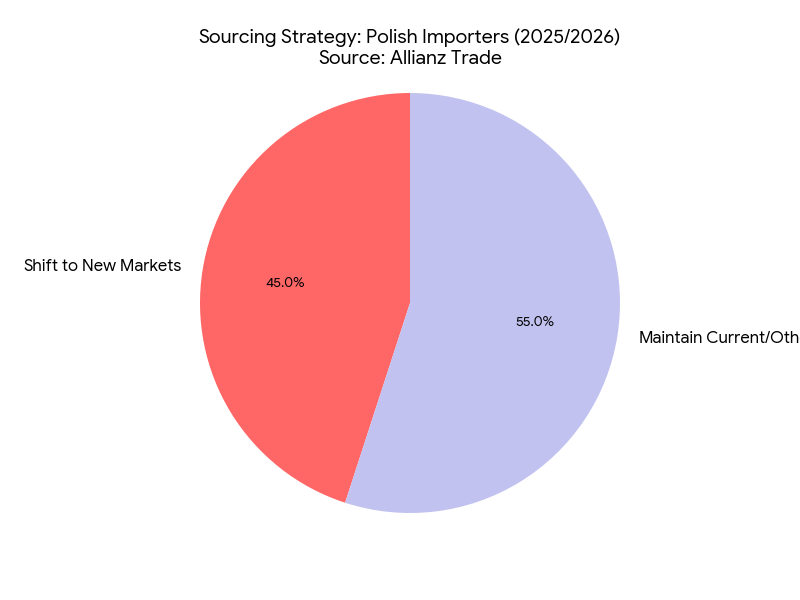
When costs rise and existing partners become too expensive, companies are forced to rapidly pivot ttheir supply chains.
-
as many as 31% of global importers have declared that they will shift their sourcing to other markets (among Polish companies, this figure has risen drastically from 29% to as much as 45%, and to 38% in Spain);
-
more than 60% of US firms are already seeking alternative supply routes to keep customs costs in check.
Issues regarding supply chain complexity, concentration, and competition have been identified as one of the top three threats by over three-quarters of surveyed companies (a significant increase compared to the previous year). According to experts, the complexity of global supply chains has doubled since 2017.
Source: Allianz — Allianz Trade Global Survey 2025
4. Forrester predictions for 2026
Forrester’s „Predictions 2026” Report shows that this year will be defined by „The Race to Trust and Value”.
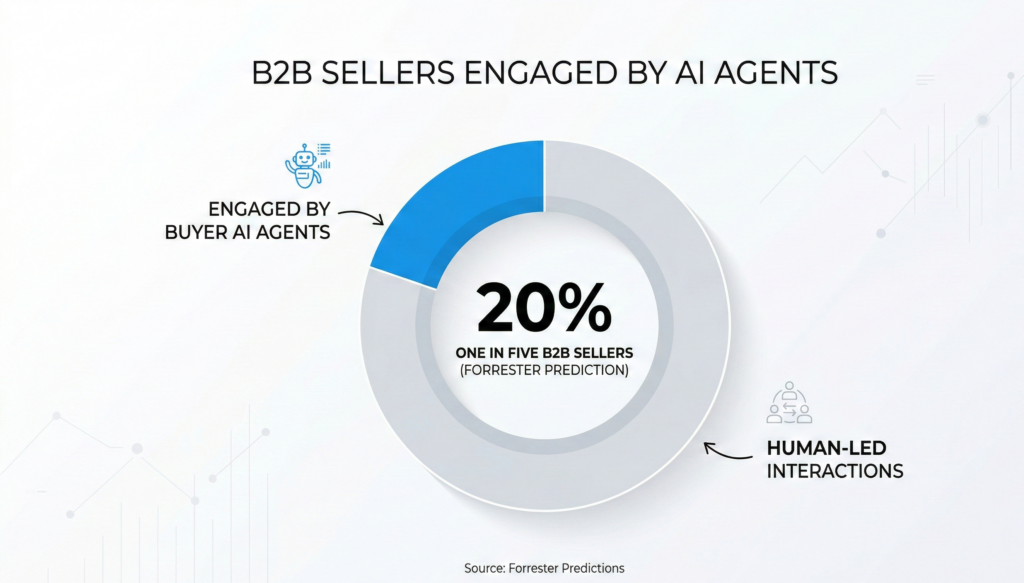
Forrester predicts that one in five B2B sellers (20%) will be forced to engage in negotiations led by AI agents representing buyers. These agents are tireless, data-driven, and capable of negotiating discounts and payment terms with hundreds of suppliers simultaneously.
2026 Landscape: Business leaders will have to navigate an environment defined by buyer empowerment, cost pressure, and a continuous need for validation. Clarity and accountability will become their greatest assets.
5. GTradX business strategy and the answer on the future – model of business strategic resilience in 2026
Implementing GTradX is a strategic decision to transition from a reactive to a proactive operational model. It is an investment in infrastructure that not only optimizes today’s operational costs but, above all, prepares the organization for the era of autonomous commerce —a landscape where trust is established through data and value is driven by the speed of adaptation.
In 2026, the line between success and stagnation is drawn at what experts call 'The Race to Trust and Value’. In an era of hyper-complex supply chains and pervasive cost pressures, traditional operating models are becoming a liability. GTradX is not merely a system—it is a strategic response to the new architecture of global trade.
According to market trends, the organizations achieving the highest levels of efficiency (so-called 'Digital Masters’) are those that have fully digitized their decision-making processes. In a landscape where nearly half of companies in key markets are announcing price increases, GTradX allows organizations to maintain their operational flexibility. As global supply chain complexity has doubled since 2017, the platform serves as a tool for rapid sourcing pivots—which is critical for the 45% of Polish enterprises currently seeking new markets.
The B2B market is evolving toward centralized environments. It is predicted that by 2026, one in three sales interactions will take place within dedicated digital spaces, eliminating inefficient, fragmented communication. GTradX addresses the need for buyer autonomy by offering an environment where transactions and negotiations occur in real-time, without information barriers.
6. Conclusions
Everything indicates that 2026 is opening new frontiers of challenges and risks for businesses, while also presenting an opportunity to build market advantages based on diversified digital tools. Despite the extensive discussions within the business environment regarding the role of AI—including the trends, threats, and opportunities arising from its use—there is no indication that this momentum is set to change.
Today, the role of the business leader is evolving from a manager of processes into an architect of business resilience. In a world where supply chain complexity has doubled in just a few years, and „The Race to Trust and Value” has become the new paradigm, traditional methods of building a competitive edge are losing their relevance. Success is no longer defined merely by the possession of data, but by the ability to verify it instantly and transform it into secure, actionable steps.
GTradX is not just another IT tool—it is the choice of an operating model that grants leaders expanded business horizons while maintaining constant control. It is not an ecosystem where business processes are handed over entirely to digital hands. In the era of the „agentic revolution,” where one in five negotiations is conducted by algorithms , this platform serves as a guarantor that technology works to protect the company’s margins, rather than undermining them.
For the 45% of Polish enterprises currently actively rebuilding their sourcing maps, GTradX is more than just a marketplace—it is the foundation of a new business identity. This identity is built on clear and transparent principles, corporate responsibility, and compliance, all of which are becoming paramount in 2026. Choosing this path means joining those organizations that do not merely adapt to change but dictate its pace within the new architecture of global trade.