
Western allies attempting to safeguard shipping routes through the Strait of Hormuz are confronting a painful lesson from the recent past. The Red Sea precedent—where years of operations against Houthi insurgents cost billions of dollars only to end in strategic failure—casts a long shadow over current efforts. Despite massive investments in defense, the shipping industry continues to largely bypass those waters, raising doubts about the effectiveness of similar naval missions.
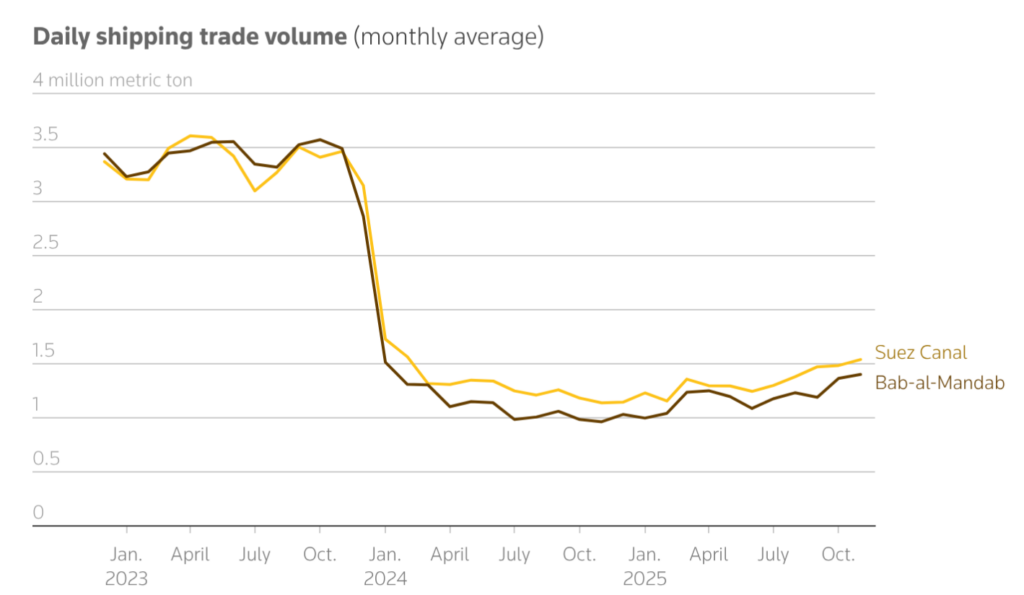
https://https://www.reuters.com/business/energy/western-powers-were-unable-secure-shipping-red-sea-hormuz-will-be-harder-2026-03-25/ The chart shows the daily shipping trade volume from the Red Sea chokepoints of the Bab-al-Mandab strait and Suez Canal with daily volume being lower by around 60% since November 2023 Houthi attacks
Why does Hormuz represent a challenge of a different magnitude?
The Strait of Hormuz is not merely a global trade bottleneck; it is a vital artery for 20% of the world’s oil and liquefied natural gas (LNG) supply. While the adversary in the Red Sea was a rebel militia, here the West faces Iran—a professional military power. The blockade of this route has already triggered historic shocks in energy markets, and failing to reopen it swiftly threatens a global cost-of-living crisis. As Sheikh Nawaf Saud Al-Sabah, CEO of Kuwait Petroleum, warned during a recent summit: „There is no substitute for the Strait of Hormuz. It is the world’s strait, protected by international law but governed by brutal market realities.”
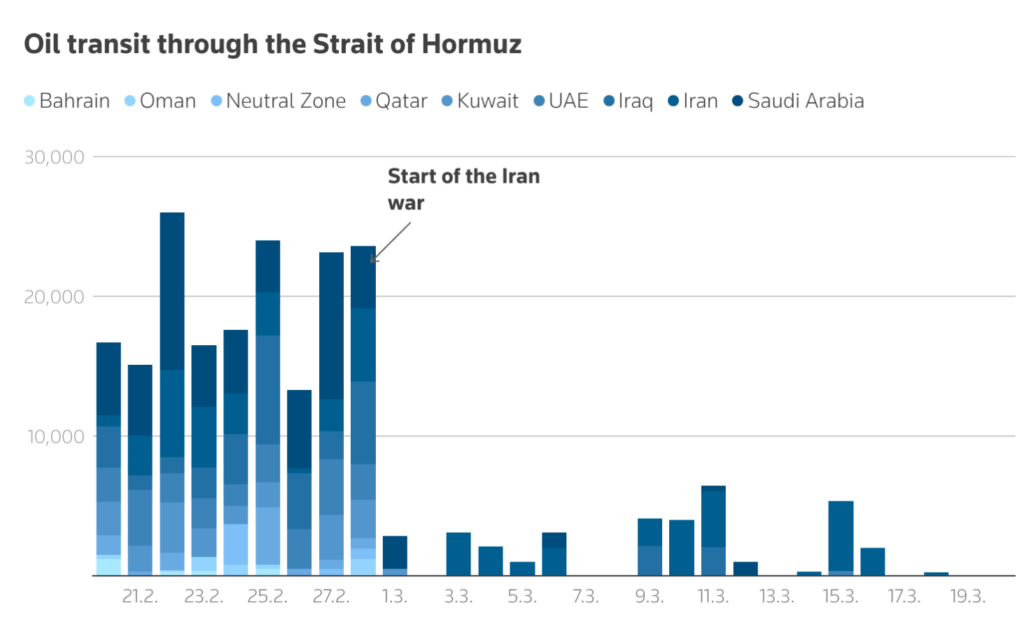
https://https://www.reuters.com/business/energy/western-powers-were-unable-secure-shipping-red-sea-hormuz-will-be-harder-2026-03-25/ Oil exports via the Strait of Hormuz
The military „trap” and Iran’s tactical advantage
While the UN Security Council debates resolutions authorizing „all necessary means” to protect the area, experts point to severe technical hurdles that make a military solution daunting. Iran’s mountainous coastline provides a natural vantage point for near-instantaneous drone and missile strikes, leaving defenders with a reaction window of just five to ten minutes. Furthermore, Iran’s arsenal includes sophisticated sea mines and midget submarines—threats the U.S. did not have to contend with during the Red Sea conflict. The complexity of modern naval defense means that a single destroyer cannot simultaneously intercept incoming missiles, sweep for mines, and repel swarms of fast-attack craft while managing intense GPS interference.
Donald Trump’s political dilemma
For the U.S. President, the situation in the Persian Gulf is a political minefield. He is forced to justify military engagement to an electorate weary of inflation as gasoline prices approach $4 per gallon ahead of the midterm elections. This pressure has led to a noncommittal stance; Trump has oscillated between promising U.S. Navy escorts and suggesting that other nations, which are more dependent on the region’s oil, should take the lead in the operation.
The path forward
Since the incidents in late February, Iran has not only maintained its blockade but is also considering imposing official transit fees on vessels. Analysts, such as Bryan Clark from the Hudson Institute, predict that restoring normal traffic will not be achieved through a single strike but will require months of intensive patrolling and mine-clearing operations. The stakes remain astronomical, as any tactical miscalculation could cost the lives of hundreds of sailors and trigger an uncontrollable regional escalation.