While the EU economy avoids a recession, CEOs are grappling with a polycrisis. Today, geopolitics, capital asymmetry, talent shortages, and the pressure of AI cause more anxiety in boardrooms than macro indicators.
Global Perspective PwC conducted its annual—now the 29th—CEO Survey, titled „Leadership in times of uncertainty and the AI era,” which measured, among other things, the enthusiasm for global GDP growth among CEOs in Poland and worldwide. According to the study, expectations for global economic growth are optimistic. Over 60% of surveyed Polish and global CEOs expect economic growth within the next 12 months. Sentiments regarding revenue present a somewhat different picture. Nearly 60% of Polish CEOs anticipate revenue growth in the short term, i.e., a 12-month period, whereas only just over 30% of global CEOs share this optimism.
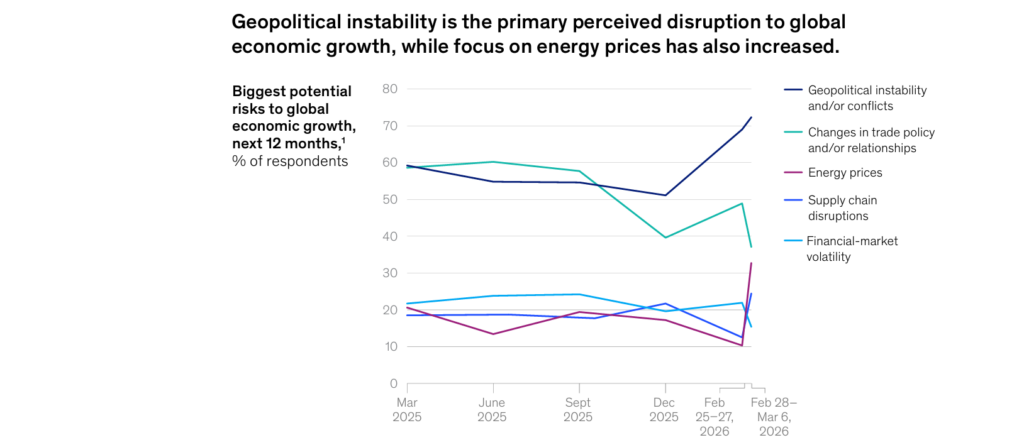
McKinsey, in its „Economic conditions outlook – III 2026”, demonstrated that geopolitical instability has overshadowed other economic risks. 72% of respondents identified geopolitical instability or conflicts as one of the key global risks. This figure has risen from the 51% reported in December 2025.
Energy prices are among the top five risks once again since mid-2023.
The McKinsey survey, much like the PwC study, indicates that respondents’ expectations regarding their own companies remain predominantly optimistic. Just over half of the private-sector respondents expect demand for their companies’ products or services to grow over the next six months, a result consistent with the previous quarter. Approximately six in ten surveyed anticipate profit growth.
However, for the first time since March 2025, geopolitical instability has emerged as the most frequently cited threat to company growth—though it is worth noting that prior to February 28, respondents were equally likely to point to trade policy changes, geopolitical instability, weak consumer demand, and rising industry competition. Geopolitical instability has also joined the top five issues respondents identify as current priorities for their companies’ leaders, overtaking trade policy concerns.
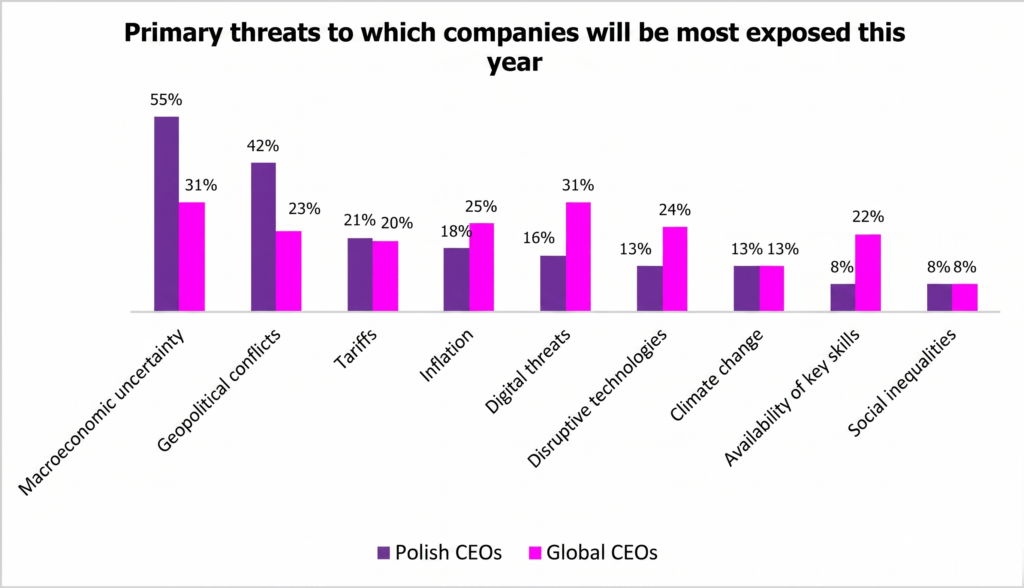
Macro-level factors remain the greatest threat to Polish companies. Macroeconomic uncertainty fueled by crises—including armed conflicts that impact all countries and sectors across the global economy—translates not only into business behavior but also consumer habits. This has a direct impact on day-to-day business operations, despite low inflation and increased investment levels.
According to the PwC survey, nearly 40% of CEOs confirmed that despite favorable economic conditions, access to investment capital remains the most significant constraint for Polish companies, while the same issue was noted by 23% of global executives.
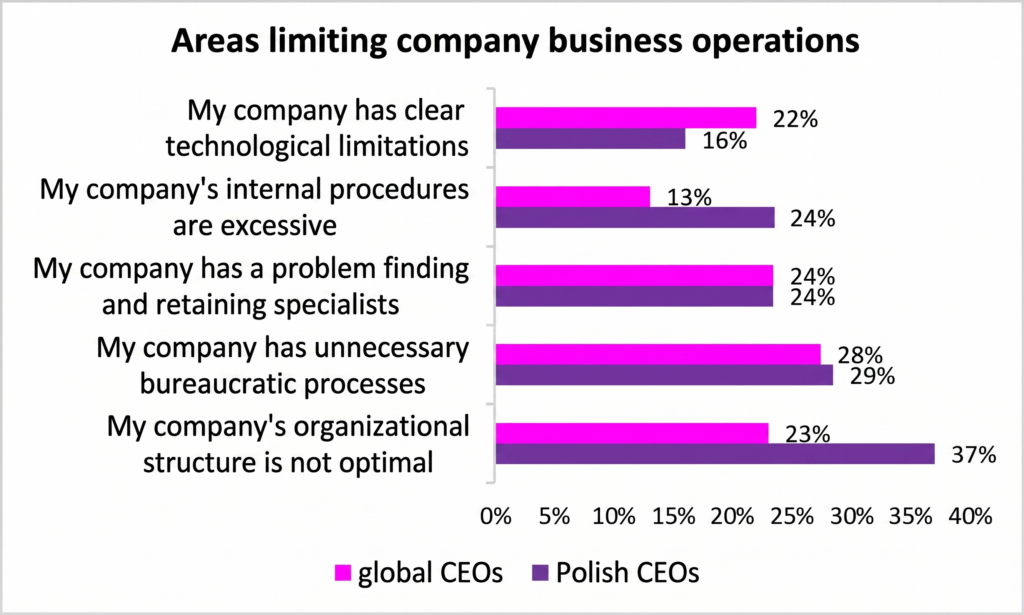
Interestingly, however, the survey also revealed that among the factors most severely limiting company operations were internal processes:
Interestingly, in the era of digitalization and AI solutions, only 8% of Polish and 22% of global CEOs perceive risks related to the availability of key skills; instead, they are primarily concerned about the pace of change in these areas. The largest proportion of Polish executives—41%, alongside 44% of global CEOs—are most worried about whether their companies are transforming quickly enough to keep pace with AI and technology. Furthermore, as many as 38% are asking themselves: „How can I balance fair employee compensation with cutting labor costs?”
The research also does not indicate that business leaders view demographic shifts and aging populations as a risk to their operations. This is likely because high market volatility and uncertainty force them to focus on business strategy and short-term risks.
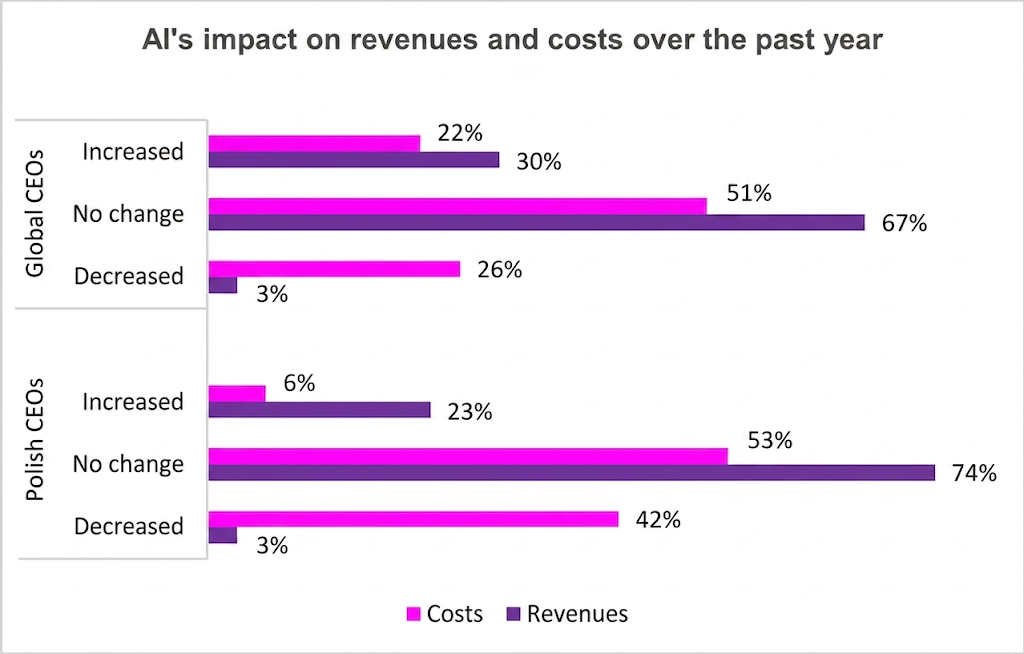
A particularly interesting finding from the survey shows that global CEOs see the greatest benefits of AI in the area of revenue generation, whereas Polish CEOs view it primarily as a tool for cost reduction.
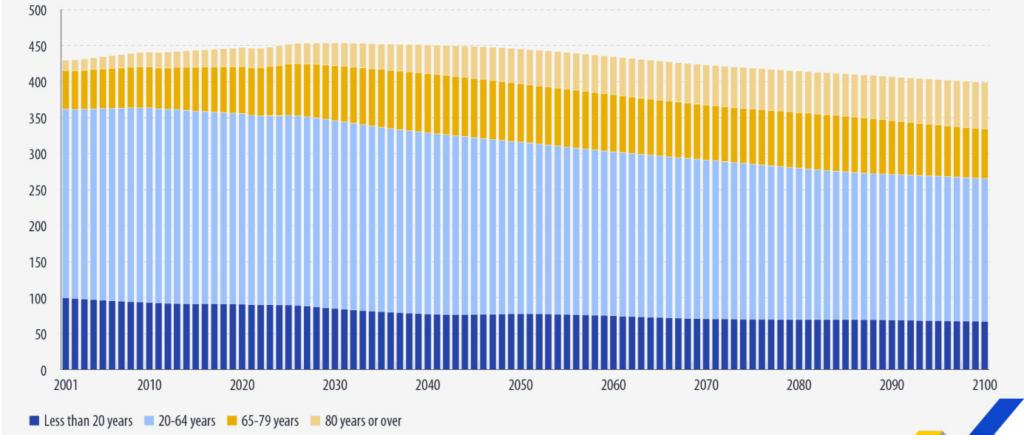
Demographics and aging populations According to the latest Eurostat demographic projections, the EU population is expected to decrease by 11.7% between 2025 and 2100. This translates to a projected decline of 53.0 million people in the EU by the beginning of the next century.
In 2025, the EU population was estimated at 451.8 million, having returned to an upward trend in 2022 following the disruptions caused by the COVID-19 pandemic in 2021. In the coming years, the population is projected to continue growing for another three years, peaking at 453.3 million in 2029, and then gradually declining to 398.8 million by the year 2100.
This information is derived from demographic projections published by Eurostat. The findings are based on assumptions regarding the partial convergence of fertility, mortality, and migration patterns across European Union member states.
EU population, observed data (2001-2024), and projected data (2025-2100)
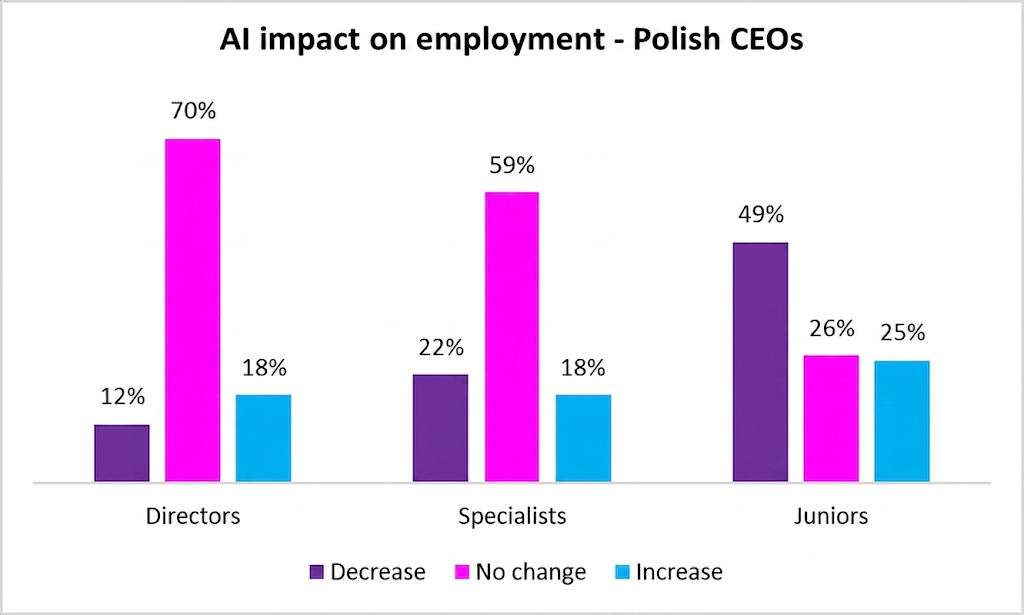
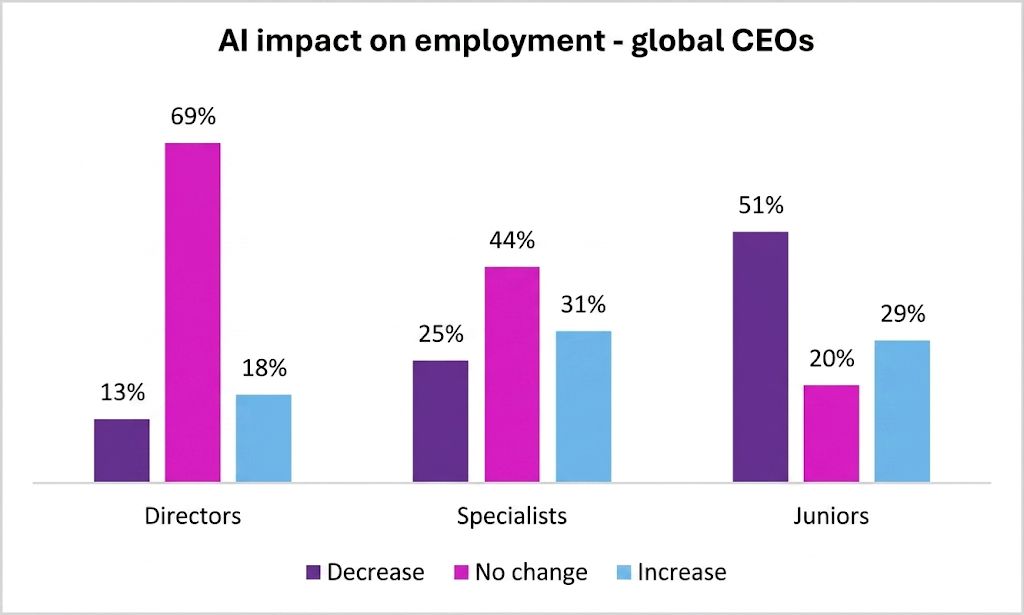
The majority of company CEOs expect that artificial intelligence will contribute to reduced hiring for junior positions. According to the PwC survey, specialists are not at risk.
Business leaders—both domestically and internationally—are currently operating in an era of permanent uncertainty and overlapping crises (the so-called polycrisis). The complexity of this landscape depends largely on industry specifics, yet the pressure exerted on executive management is reaching unprecedented levels.
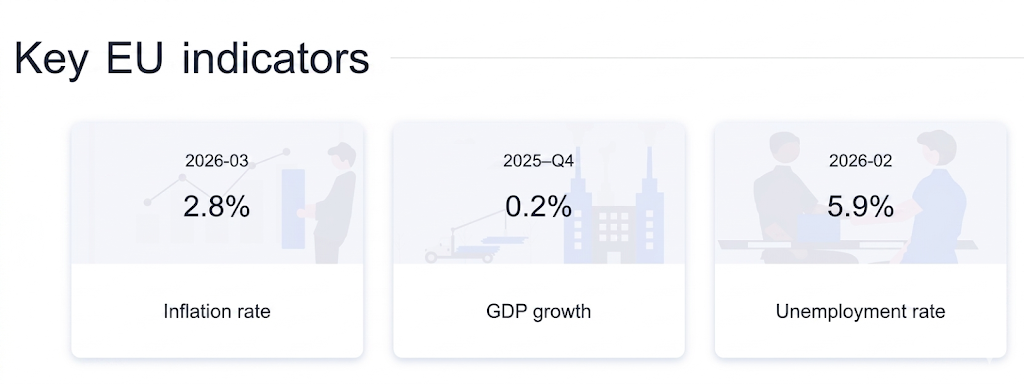
Paradoxically, this sense of threat is occurring amidst a relative, and seemingly favorable, macroeconomic stabilization on the Old Continent. As the latest key indicators for the European Union demonstrate, the macro environment is improving following the turbulence of previous years. The inflation rate is clearly decelerating, reaching 2.8% in March 2026, which brings it closer to central banks’ targets. The European economy has managed to avoid a deep recession, recording a positive, albeit modest, GDP growth of 0.2% in the fourth quarter of 2025.
Furthermore, the European labor market remains exceptionally robust, as evidenced by a low unemployment rate (5.9% in February 2026).
It might seem that such an economic „soft landing” provides ideal conditions for growth. Why, then, are CEO concerns growing? It stems from the fact that stable macroeconomic indicators do not solve the deep structural problems that companies face on a daily basis.
From a local perspective, one of the most pressing challenges remains the asymmetry in access to capital, which directly translates into an uneven playing field in the European Single Market. A prime example of this can be found in the recent observations made by the CEO of a leading Polish window and door manufacturer. He highlighted the phenomenon of a de facto imbalance within the European Union. While theoretically, everyone is subject to the same regulations and oversight by EU institutions, in practice, competitive advantages are built on access to massive, cheap investment capital, shielded by barriers to entry.
To illustrate the scale of the capital challenges facing Polish enterprises compared to global players, one need only compare the annual net profits (for 2022) of just three Danish corporations with the entire pool of non-repayable grants allocated to Poland under the National Recovery Plan (spread over 5 years):
Maersk: ~€30.25 billion
Novo Nordisk: ~€7.46 billion
LEGO: ~€2.37 billion
NRP grants for Poland (5 years): €25.27 billion (which accounted for approx. 0.6% of Polish GDP).
The above comparison brutally exposes the disparity in investment capabilities, research and development (R&D) spending, and the capacity for aggressive market expansion between Polish companies and Western giants.
However, the capital gap is only a fraction of the broader picture. As clearly shown by analyses of CEOs’ risk perceptions, a healthy EU macroeconomic environment is not enough to guarantee security. Today’s management boards must navigate a maze of overlapping operational and strategic challenges:
Demographic shifts and talent shortages: This is a perfect example of how positive macro data becomes a business challenge. The previously mentioned low unemployment rate (5.9%) means, from a company’s perspective, a drain of skilled workers from the market, immense wage pressure, and the need to seek out costly forms of process automation.
Energy costs and ESG transformation pressure: Despite a drop in overall inflation, global energy costs are once again returning to the forefront of risks. Companies, particularly those in Central and Eastern Europe, face the massive challenge of financing the green transition to avoid being excluded from EU supply chains governed by the CSRD directive.
Geopolitical instability and market fragmentation: International turmoil and growing economic protectionism are forcing companies to constantly reconfigure their supply chains (nearshoring), often at the cost of higher financial outlays.
Technological revolution and GenAI: The rapid adoption of generative artificial intelligence is a prerequisite for maintaining competitiveness. However, it requires massive capital investments in infrastructure, cybersecurity, and workforce reskilling.
Wir verwenden notwendige Cookies, um die Plattform zu sichern und den Datenverkehr zu analysieren (GA4). Analytik wird nur aktiviert, wenn Sie auf "Initialisieren" klicken. Mehr dazu in unserer Datenschutzerklärung.